

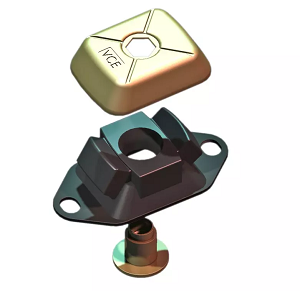
How can my boat be quieter and my sailing more relaxed?
Have you ever enjoyed a nice boat trip but then had to turn the throttle back because of the noise? For relaxation, you want to be able to hear each other, right? Consider a flexible engine mount.
A flexible engine mount
With a flexible engine mount, you use engine supports. These supports reduce noise and vibrations as much as possible.
Sailing without vibration
What is the key to sailing without (too much) vibration and having a relaxing sail? The principle is simple. You remove the rigid connection between the engine and the foundation. This transmits the vibrations from the engine. Let the engine float on its foundation, and the noise is gone. Start with the basics.
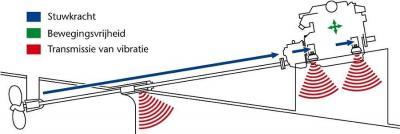
Why do engines vibrate?
Engines have internal components that move quickly back and forth. In milliseconds, the piston is forced down by an explosion and then pushed back up by the crankshaft at the same speed for a new compression stroke. With short piston strokes and aluminum engine blocks, modern engines are made compact and lightweight. This provides many advantages, such as space savings and lower production costs. A disadvantage is that vibrations are less dampened and absorbed due to the low weight. Also, the shorter engine stroke requires higher RPMs to stay running. As you know from experience, the more throttle you give, the more noise you get.
Loose support of the engine
That’s why it is important to ensure a good and solid foundation for the engine with soft engine supports. The supports essentially decouple the engine from the boat’s foundation. The best option is a soft enough engine support that is still strong enough to support the weight of the engine, reverse gear, and part of the propeller shaft.
As soft as possible rubber
The softness of rubber is expressed in SHORE with a number for hardness. Additionally, the letter A to D determines in which category the rubber belongs. Rubber with a SHORE of 10 is very soft, and above that, it becomes firmer. A heavier engine requires firmer rubber to ensure that the rubber isn’t pressed out by the weight. Engine supports usually start at 35 SHORE. Look for rubber that is soft enough, but still firm enough to support the engine. The softness and quality of the rubber often determine the final price and durability.
Don’t skimp on the price of good engine supports. Cheaper engine supports, like washing machine mounts, sometimes work well but aren’t always resistant to oil, grease, and diesel fumes in the engine compartment.
Too soft?
With too soft engine supports, the strength is lost in the pull and thrust motion made by the propeller shaft and engine during maneuvering. You can choose V-engine supports, which lock the engine in place under load with their V-shape. However, this does reduce damping because the engine pushes against the rubber.
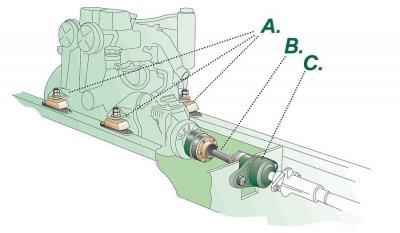 So what is the optimal engine mount?
Do you want optimal damping? A combination of flat vibration dampers with a thrust/bearing is the best solution. A thrust/bearing keeps the propeller shaft in place. It is a bearing that absorbs forces from all directions. This is also suspended in rubbers and mounted between the reverse gear and the propeller shaft. After installation, it must be precisely aligned to prevent overload of the bearings and shaft seals. Even better is placing a flexible (homokinetic) coupling between the coupling and shaft, allowing all parts to continue rotating without stress, even under load and possible shifting.
Example setup of a homokinetic engine mount
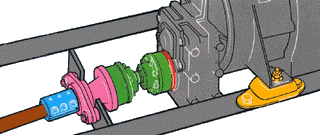 Propeller shaft brown
- Clamp hub blue
- Thrust bearing pink
- Homokinetic coupling green
- Adapter flange red
- Engine mount/vibration damper yellow
Advice for less vibration while sailing
Looking for less vibration and more relaxation? Or a better engine setup? Take a close look at the foundation of the engine setup. Can this be improved? Feel free to consult with our specialists. Each engine and coupling brand requires its own force calculations. Based on this data, we can develop a plan for you.
As preparation, we’d like the following details:
– Brand and type
– Maximum RPM
– Number of cylinders
– Engine weight
– Thrust bearing installed
AB Marine Service provides setups for any brand, type of engine, and reverse gear. Request your own relaxing sail today.

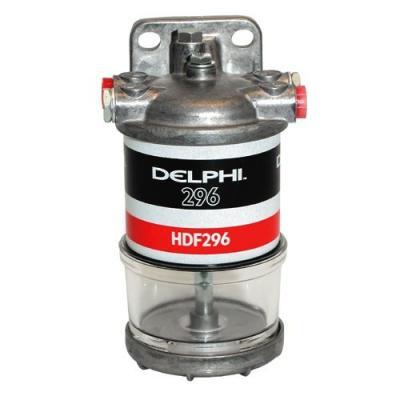 A fuel tank is often installed inside. In the evening, the tank cools down and warms up again during the day. The oxygen that moves through the warming and cooling process always contains moisture. Warm air that cools down forms water droplets (rain), and this condenses against the walls of the tank. This water drips down and settles at the bottom of the tank, below the diesel. Diesel has a lower specific gravity than water. A practical tip is to keep the space above the fuel as limited as possible. Always fill the tank completely before leaving the boat unused for a long time (for winter storage with winter diesel). After all, the less space there is at the top of the tank where oxygen and condensation can settle on the walls of the tank, the better. Warm and moist conditions are also perfect for diesel bacteria to grow rapidly, but even during winter, diesel bacteria can thrive. A clean and dry tank vent in the right place is therefore recommended. Rain and wave action Even incorrect placement of, for example, the fuel fill or vent can quickly cause water accumulation in the tank. Rainwater that can seep in through an external vent, or splashes of waves hitting the deck, can get into your tank, so this needs to be taken into account. Also, pay attention to a proper seal of the diesel fill cap on the outside and periodically check the seals in the cap. Is this new? Diesel today must contain less sulfur than in the past, as required by the government. Sulfur that you burn is highly polluting for the environment, but sulfur used to prevent bacterial growth in the past. In addition, a few percent of biodiesel is now added to diesel. Biodiesel is made from plant-based products and is therefore interesting as the world’s oil reserves are depleting. But biodiesel has the property of quickly attracting water and contains a higher percentage of microbes. What can you do?
  If possible, check visually if you can see water formation in the tank, often you’ll see a large “bubble” of water at the bottom. If you have never checked or drained it, that’s a good start. Do you frequently encounter this problem? Look at what the cause might be, as described above, such as malfunctioning venting, etc. The fuel supply pump that delivers fuel to the engine also often pumps the diesel back into the tank several times through the return line. This way, your tank is often kept clean and filtered. A proper filter installation with a water separator can catch water from your tank. Since water is heavier than diesel, it is collected at the bottom of the glass. Through the glass, you can also see whether your diesel is clean or maybe cloudy, which indicates contamination. Do you experience a lot of contamination and have trouble draining the tank? Then you can opt for an external pumping system that continuously circulates the diesel through a filter set and separates the water.
 Get quick help via Whatsapp, click here!